
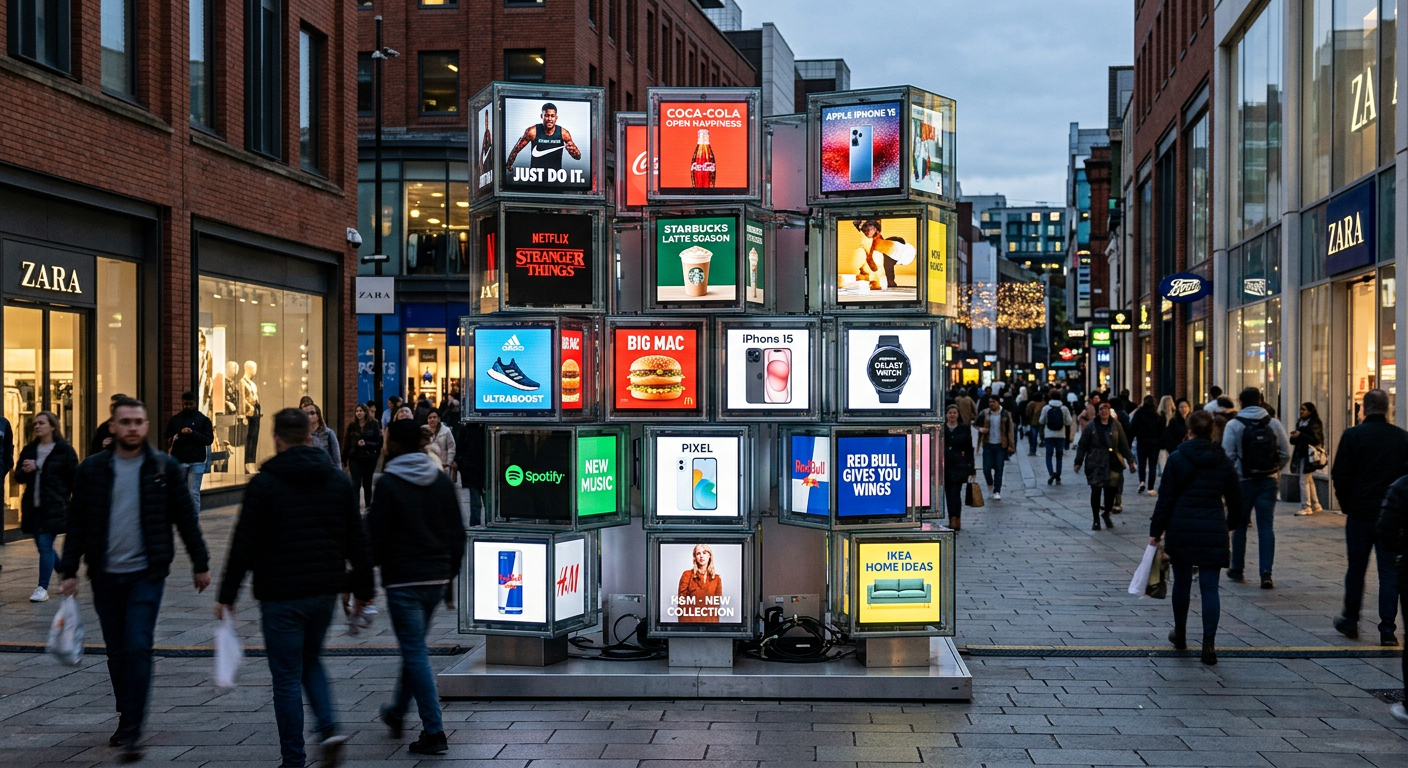
How Per-Impression Billing Changes DOOH
One advertisement.
One operational screen.
One completed ad play.
One impression.
It sounds simple.
But defining DOOH this way can fundamentally change how residential digital advertising is bought, sold, measured, and paid for.
The Problem with Selling Screens
Traditional DOOH can sometimes be sold in broad packages.
An advertiser may be offered a certain number of screens for a particular period, perhaps with a fixed campaign fee.
That approach is easy to understand at a high level.
But it leaves an important question unanswered:
How much advertising was actually delivered?
A screen being installed does not mean an advertisement was played.
A screen being listed in a media plan does not mean it was operational.
And a campaign being booked for 30 days does not automatically tell us how many times the audience actually received the advertisement.
Digital media should be able to do better.
Define the Unit
At AdX, the basic idea is straightforward:
One ad play on one operational screen equals one impression.
This definition creates a common unit for the marketplace.
If an advertisement plays once on one operational screen, that is one delivered impression.
If it plays 100 times across 10 operational screens, that is 1,000 impressions.
The arithmetic is simple.
The implications are significant.
Advertisers Pay for Delivery
With per-impression billing, the advertiser's expenditure can be directly connected to delivered advertising.
Instead of paying primarily for the existence of a screen, the advertiser pays for advertising activity.
This makes budgeting easier.
Suppose a campaign is priced at ₹0.01 per impression.
A campaign delivering 10 lakh impressions would have an advertising value of:
10,00,000 × ₹0.01 = ₹10,000
The advertiser can understand exactly what the number represents.
Operational Status Matters
This model also makes screen uptime commercially important.
If a screen is not operational, it cannot generate an impression.
That creates a strong incentive for the network to maintain reliable screens.
It also prevents a simple but important mismatch:
Installed screen ≠ delivered impression.
A screen may be physically present but unavailable because of a power issue, hardware failure, connectivity problem, maintenance, or other operational reason.
Per-impression accounting naturally accounts for this distinction.
Frequency Becomes Measurable
Per-impression billing also creates a better way to think about frequency.
Consider two campaigns.
Campaign A delivers 1,00,000 impressions.
Campaign B delivers 5,00,000 impressions.
The difference is immediately visible.
The advertiser can then decide whether it wants greater reach, greater frequency, or a combination of both.
This becomes especially useful in residential environments where the audience is relatively recurring.
The same resident may encounter the same advertisement multiple times.
That repetition is not necessarily a flaw.
For many brands, repeated exposure is precisely the objective.
Pricing Becomes Easier to Compare
A standardized impression unit also makes different inventory pools easier to compare.
Suppose one location is priced at ₹0.01 per impression and another at ₹0.02.
The advertiser now has a clear starting point for evaluating the difference.
The higher-priced inventory may still be worth it.
Perhaps the audience is more valuable. Perhaps the location performs better. Perhaps the advertiser wants a specific geography.
The important thing is that the pricing difference can be expressed through a common unit.
Societies Become Measurable Participants
The same principle applies to societies.
If a society has operational screens delivering advertising impressions, its contribution can be measured.
Instead of treating every society as an identical fixed-value location, the network can account for actual advertising activity.
This can create a much more transparent relationship between media demand and society economics.
It Creates Accountability on Both Sides
Per-impression billing is not only beneficial for advertisers.
It also creates accountability for the network.
The network has to deliver.
If a campaign is purchased for a particular number of impressions, those impressions need to actually happen.
This shifts the conversation from promises about potential exposure to measurement of actual delivery.
It Also Creates a Common Language
One of the biggest benefits of standardization is that different participants can finally talk about the same thing.
An advertiser can say:
"I want 50 lakh impressions."
A network can respond:
"We can deliver those impressions across these locations."
A society can see:
"Our screens contributed this many operational impressions."
The operator can calculate:
"This campaign generated this much billable inventory."
Everyone is working from the same underlying unit.
What About Audience Size?
An impression should not be confused with a unique person.
If one resident sees the same advertisement five times, that may represent five ad plays, but it does not necessarily mean five different people saw it.
That distinction matters.
Per-impression billing is fundamentally about delivery of advertising plays, not claiming that every impression represents a unique individual.
Audience measurement can be layered on top of this later.
The first requirement is to establish a reliable, auditable delivery unit.
One Small Definition Can Change the Economics
That is why the definition matters so much.
"Screen for one month" is a broad commercial concept.
"One impression" is a measurable unit.
Once advertising is converted into measurable units, pricing, reporting, reconciliation, campaign planning, and revenue sharing can all become more transparent.
The industry can still negotiate rates.
It can still offer discounts.
It can still create packages.
But underneath those commercial structures is a clearly defined unit.
The Principle Behind AdX
We believe DOOH should move towards a model where advertising value follows actual delivery.
Not simply:
How many screens do you have?
But:
How many advertising impressions can you reliably deliver?
And ultimately:
How many impressions did you actually deliver?
That is a much cleaner foundation for a modern DOOH marketplace.
One screen.
One ad play.
One impression.
A simple definition can create a much fairer system.